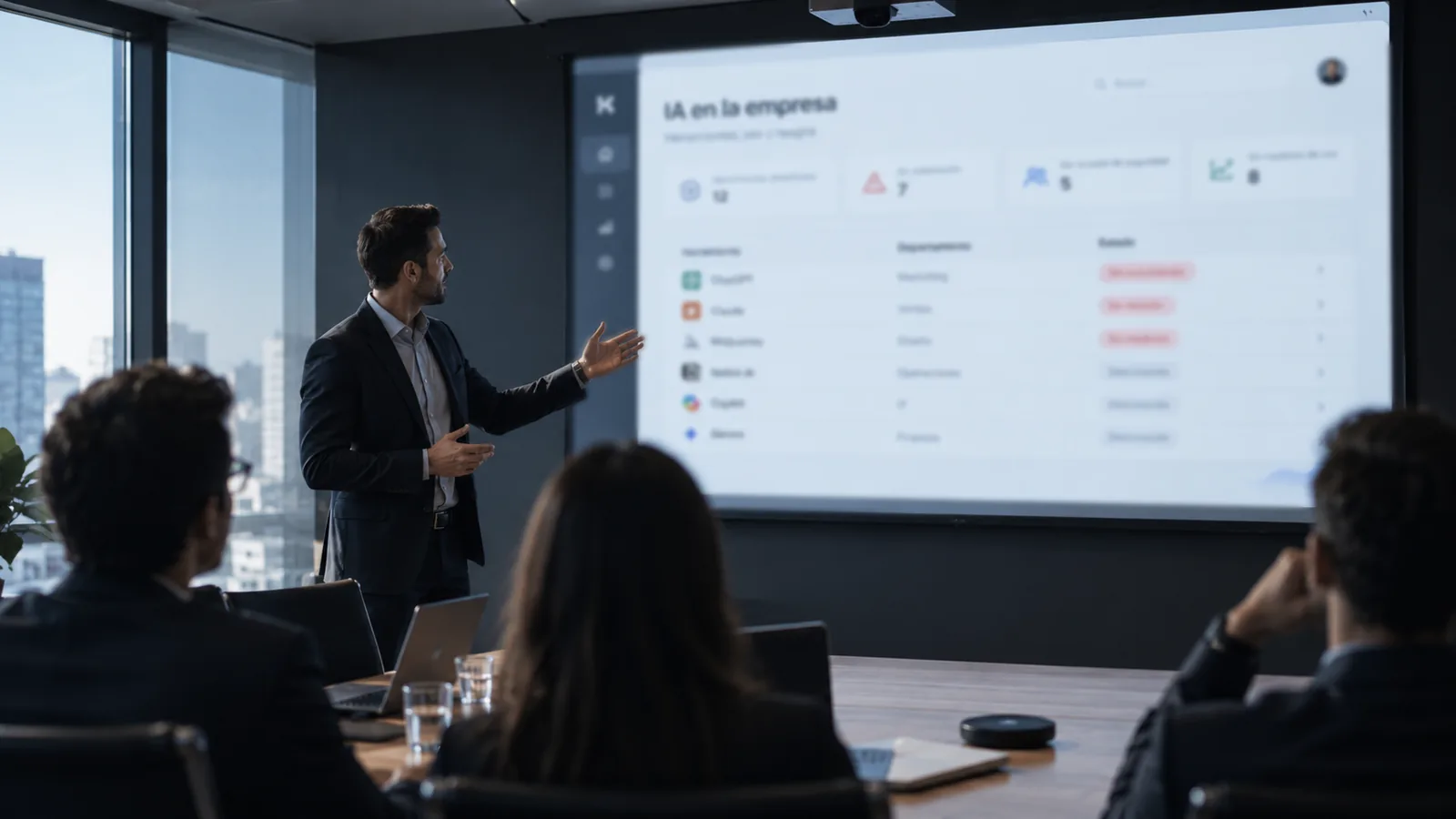
AI nobody approved, nobody reviews, nobody measured
The short version · 4 key points
- Security incidents involving AI tools adopted without approval rose from 20% to 43% in one year (IBM, 2026).
- The share of organizations with no AI governance policy went up, not down: from 63% to 68% (IBM, 2026).
- Eight in ten users report being more productive, yet only 37% of companies see it in their EBIT (McKinsey, 2026).
- This isn't a technology problem or a people problem. Nobody was put in charge.
You're reviewing the month-end close, and somewhere in operating expenses there's a scattering of AI subscriptions across different departments. None of them large on its own. All of them recurring.
You stop on that line and realize you can't answer three basic questions: how many tools there actually are, what each one does, and whether any of them produces something worth what it costs. Nobody in the company has that list, because building it was never anyone's job.
It isn't negligence. Every team solved a problem with what it had at hand, which is exactly what you want from capable people.
But the result is three blind spots at once: you don't know which tools are running, you don't know whether you're paying what you should, and you won't be able to show whether any of it worked. All three are the same kind of problem. They aren't technical failures. They're decisions nobody made.
Blind spot one: what's running
IBM's Cost of a Data Breach Report 2026, conducted with the Ponemon Institute across 602 organizations that suffered a breach between March 2025 and February 2026, carries the number that should get your attention: incidents involving AI tools adopted without approval, what the industry now calls shadow AI, went from 20% to 43% in a single year. They more than doubled.
What comes next is worse, because it's no longer about the risk but about the response. In the same study, 68% of the affected organizations had no AI governance policy, up from 63% the year before, and only 19% say their governance and security teams actually work together. Put simply, exposure doubled while the organizational response went backwards.
The instinctive reaction is to ban it, and it's worth understanding why that doesn't work before you try. Block corporate access and the tool doesn't disappear. It moves to the personal phone of whoever was using it, and you go from a problem you could see to one you can't. You also send the message that finding a better way to work was wrong, so next time nobody tells you.
What you need isn't to close the door. It's to know what already came through it.
Blind spot two: what you're paying for
Before the number, something almost nobody explains, and it changes how you read that line on the statement.
These tools aren't billed like the software you're used to. You don't pay per seat or per license. You pay for usage: every request is charged by the amount of text that goes in and comes out. The unit is called a token, a chunk of text roughly the size of a short word, and some vendors package it as credits, which is the same thing under another name.
That leads to two practical consequences, and they're the only ones you need to keep.
First, your bill doesn't depend on how many people have access but on how much the tool gets used. Ten light users can cost less than one person running it all day, which breaks the per-seat logic most software budgets are built on.
Second, not every task needs the same tool. The most powerful models cost several times more than the mid-tier ones, and work like summarizing meeting notes, sorting email or drafting a first pass runs perfectly well on a lighter option, with a result just as useful for that purpose. But when nobody decided which task runs on which tool, everything ends up on the most powerful one, because that's the default and nobody has a reason to change it.
Now the number. On September 22, 2026, within hours of each other, Anthropic and OpenAI cut their prices, in some cases to half of what the previous versions cost. It wasn't a one-off: prices have come down with every generation.
And yet some companies are paying more than they did last year.
Part of that is healthy, because usage grew. The unhealthy part is that a price cut doesn't reach your invoice on its own. Someone has to notice that a more efficient option exists, confirm it holds the quality your operation needs, and change the configuration. If that job isn't assigned to anyone, you keep paying last year's rate for work that now costs less.
And when you don't know which tools you have or who pays for them, you can't even evaluate whether to switch. The first blind spot is costing you money inside the second.
Blind spot three: what it's producing
This is the one you notice least, and the one that costs the most when someone asks for results.
In McKinsey's The state of AI in 2026: On the road to ROI, published in August 2026 with 1,719 participants, eight in ten people who use AI say it improved their personal productivity, while only 37% of organizations report any positive contribution to EBIT.
That gap is the most important number in this article. The individual improvement is real, widespread and verifiable. The organizational one doesn't show up.
There are two explanations, and both apply. One is that time saved doesn't always reach the P&L. If someone finishes in two hours what used to take five, and those three hours aren't redirected to anything, the savings exist but never get booked.
The other is simpler. When a tool comes in through the fast lane, nobody stops to write down how long the process used to take, what it cost or what its error rate was. That's understandable: whoever adopted it wanted to get their work done. Twelve months later the improvement can be real and felt across the operation and still not exist in any report, because there's no baseline to compare it against. We wrote in an earlier article about what happens when that question reaches the boardroom.
All three are the same problem
Tools came in that nobody approved, spend grew that nobody reviews, and the chance to prove a result that nobody defined was lost.
These aren't three separate problems but three consequences of the same gap, and they feed each other: without an inventory there's no spend control, and without spend control there's no way to calculate a return.
AI entered companies differently from almost everything else. It came through several doors at once, often free at first, and almost always from the bottom up. By the time it reached your desk, it was already part of the operation.
No company lets every department hire whoever it wants, on its own budget and without telling anyone, and then asks a year later what those people produced. With AI, that's exactly what happened, and it happened without anyone deciding it.
Where to start
You don't need a project or a new budget. You need four things, in this order, and the first two take a week.
Build the inventory. Which tools, in which department, for which task, and who pays for them. A spreadsheet is enough. Do it by asking, not auditing: if people feel it's a witch hunt, half the tools won't make the list.
Put a name on each one. Not a department, a person. Someone who decides whether it stays, expands or gets shut off. When the owner is an entire department, in practice nobody owns it.
Define what it takes for a new one to come in. Not a three-month procurement process, just two or three clear criteria and, above all, one line nobody crosses: which company and customer data never goes into an outside tool.
Pick one measure per tool. What was expected of it and what it's compared against. If there's no prior baseline, capture it now and compare in six months. It's late, but it's far better than continuing with nothing.
That is what managing AI means, and it's the part nobody took on when the first tool came in. It isn't control for its own sake. It's what your company already does with every other resource that costs money and touches customer data.
The question worth closing on isn't how much it returned. It's simpler, and the answer says a lot.
When did you find out about each of the AI tools your company is running today?
If, in most cases, the answer is "after the fact," you already know where the problem is. And it isn't your people.
Sources
- IBM Security and Ponemon Institute. Cost of a Data Breach Report 2026. July 29, 2026. 602 organizations with breaches between March 2025 and February 2026, across 16 countries and regions and 17 industries. View study
- McKinsey & Company. The state of AI in 2026: On the road to ROI. August 25, 2026. Global survey of 1,719 participants, fielded May 4 to June 8, 2026. View study
- Engadget. Anthropic and OpenAI announce more powerful (and cheaper) AI models. September 22, 2026. View article